
IoT building blocks
Our IoT building blocks
Four parts we designed, certified and maintain ourselves. Each one takes a piece of risk out of your project before it starts, and each is a product in its own right, sold and supported through QuickSpot.io and BlueCherry.io.
A connected product normally needs three specialists: one for the electronics, one for the embedded software, one for the platform. Coordinating them is where budgets and schedules go. On a DPTechnics project that gap is already closed before you start.
Everything here is open to you. The Walter schematics are published under GPLv3, the software libraries are on GitHub, and BlueCherry keeps no private device data in the cloud. Nothing in this list creates a dependency you cannot walk away from.
01 Cellular IoT module
Walter
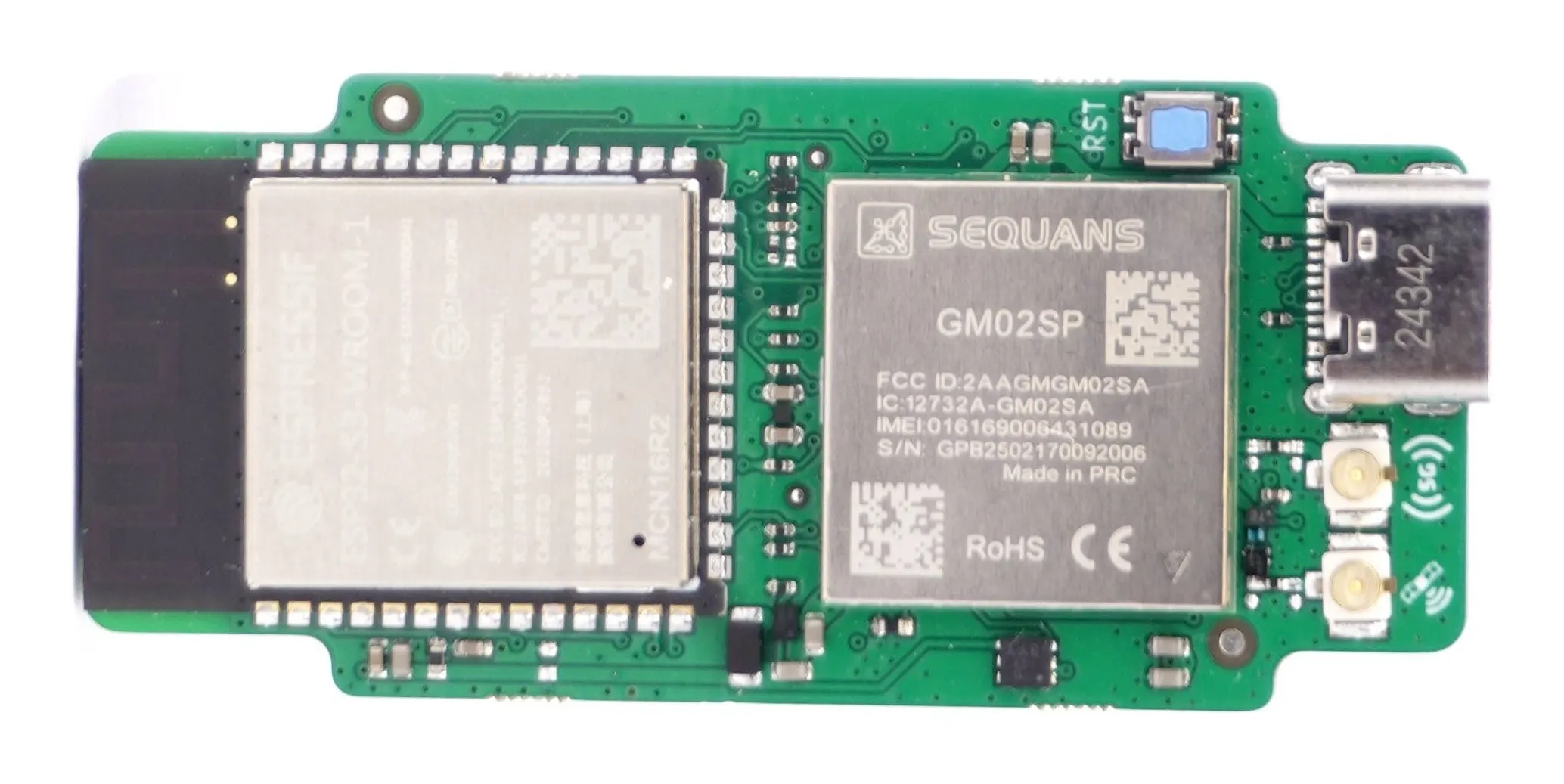
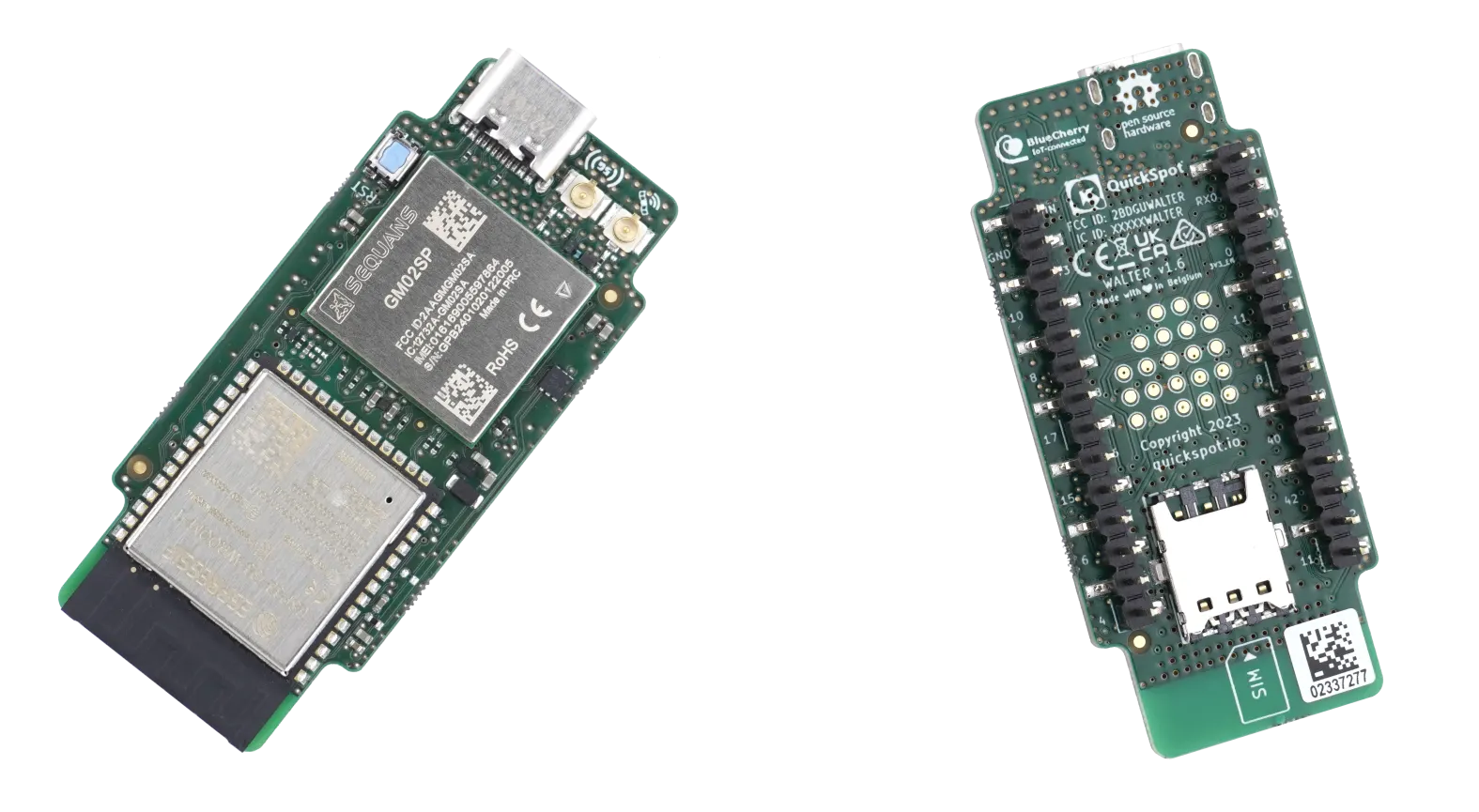
An ESP32-S3 and a Sequans GM02SP modem on one board of 55 by 24.8 mm, with LTE-M, NB-IoT, WiFi, BLE and GNSS. Certified in five regions and drawing 9.8 microamps in deep sleep.
Walter puts a dual core ESP32-S3, 16 MiB of flash and 2 MiB of RAM next to a second generation Sequans GM02SP LTE-M and NB-IoT modem with an integrated GNSS receiver. The ESP32-S3 brings its own UART, SPI, I2C and CAN peripherals plus WiFi b/g/n and BLE, and a RISC-V ultra low power co-processor for the work that has to continue while the main cores sleep.
The module is already certified for CE, FCC, IC, RCM and UKCA. A product built on Walter that adds no further radio keeps its certification scope, cost and risk small. FCC ID 2BDGUWALTER.
The design is open. Schematics are published under GPLv3. The KiCad footprint and the full datasheet, with every pin and test pad, are on GitHub. The cellular and GNSS libraries are open source and actively maintained for ESP-IDF, Arduino, MicroPython, Zephyr and Toit. Walter is also pin compatible with the discontinued PyCom GPy, so existing carrier boards can be reused without a redesign.
Specifications
- ESP32-S3, dual core, 16 MiB flash, 2 MiB RAM, RISC-V ULP co-processor
- Sequans GM02SP LTE-M and NB-IoT modem with integrated GNSS
- 9.8 uA total draw in deep sleep with the modem in PSM, low enough for energy harvesting
- No exposed strapping pins, so every peripheral can be routed anywhere on your board
- Certified CE, FCC, IC, RCM and UKCA. FCC ID 2BDGUWALTER
- Pin compatible drop-in for the end of life PyCom GPy
- Designed and manufactured in the European Union
02 Broader coverage, same footprint Coming Q4 2026
Walter Cat 1 bis
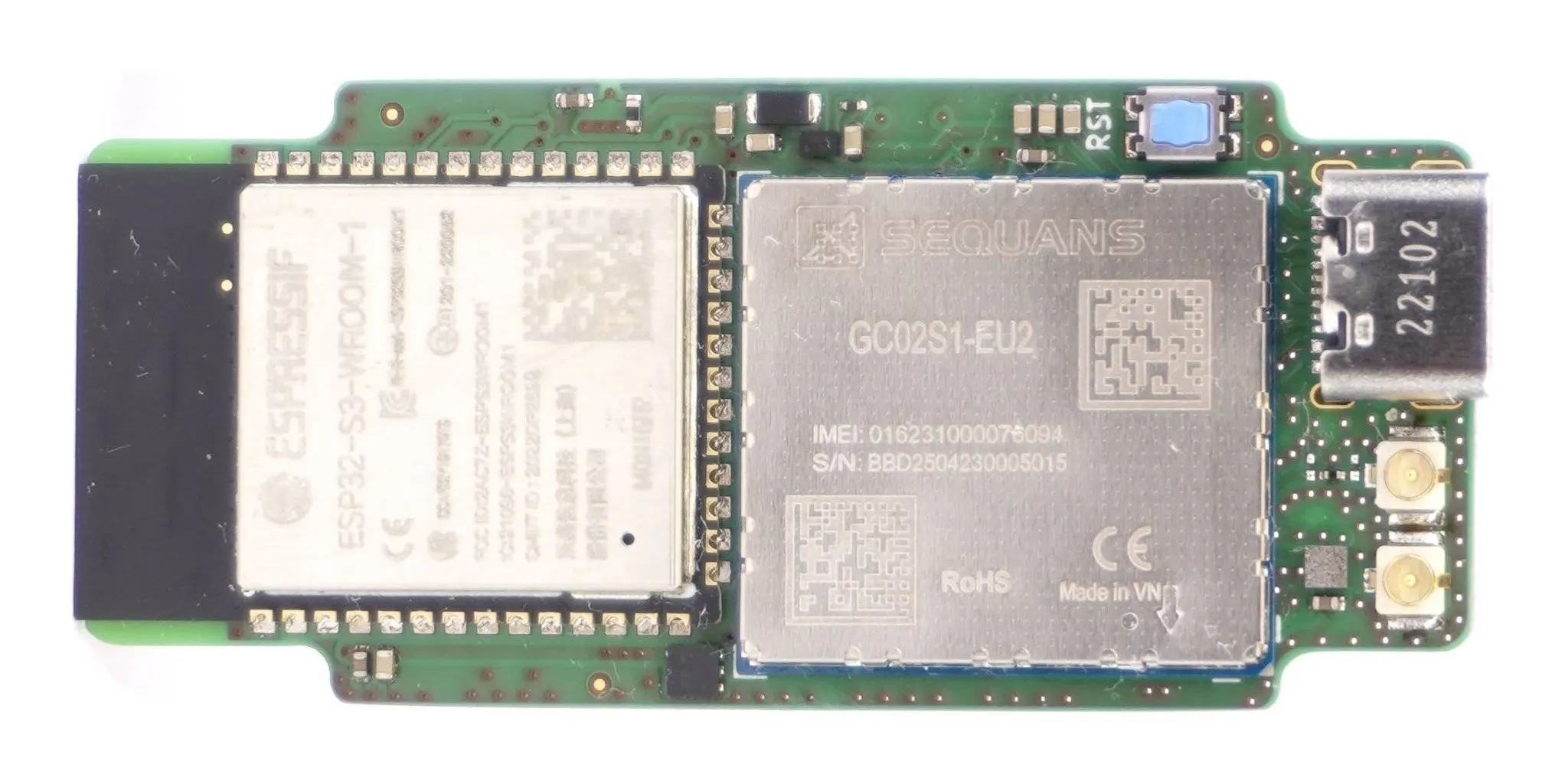
The same module, the same software, a Cat 1 bis modem. For products that need wider coverage, higher throughput and global roaming rather than the lowest possible power.
LTE-M and NB-IoT are the right choice for a battery powered sensor, but they are not available everywhere and they are slow. Walter Cat 1 bis answers that with a Sequans GC02S1 Cat 1 bis modem: broader network availability, higher speeds and global roaming, in exactly the same form factor.
It is a drop-in replacement. Same pinout, same libraries, same toolchains, no hardware changes to a board designed for Walter. You can pick the network profile per market, or switch later, without touching your design.
Extended roaming and compatibility with low earth orbit satellite services are on the roadmap. The module is certified for CE, FCC, IC, RCM and UKCA, and ships in the fourth quarter of 2026.
Specifications
- Sequans GC02S1 Cat 1 bis modem, plus WiFi and BLE
- GNSS hardware ready
- Identical 55 x 24.8 mm footprint and identical software stack
- Drop-in replacement for Walter with no hardware changes
- Extended roaming and LEO satellite compatibility on the roadmap
- Certified CE, FCC, IC, RCM and UKCA
03 IoT platform
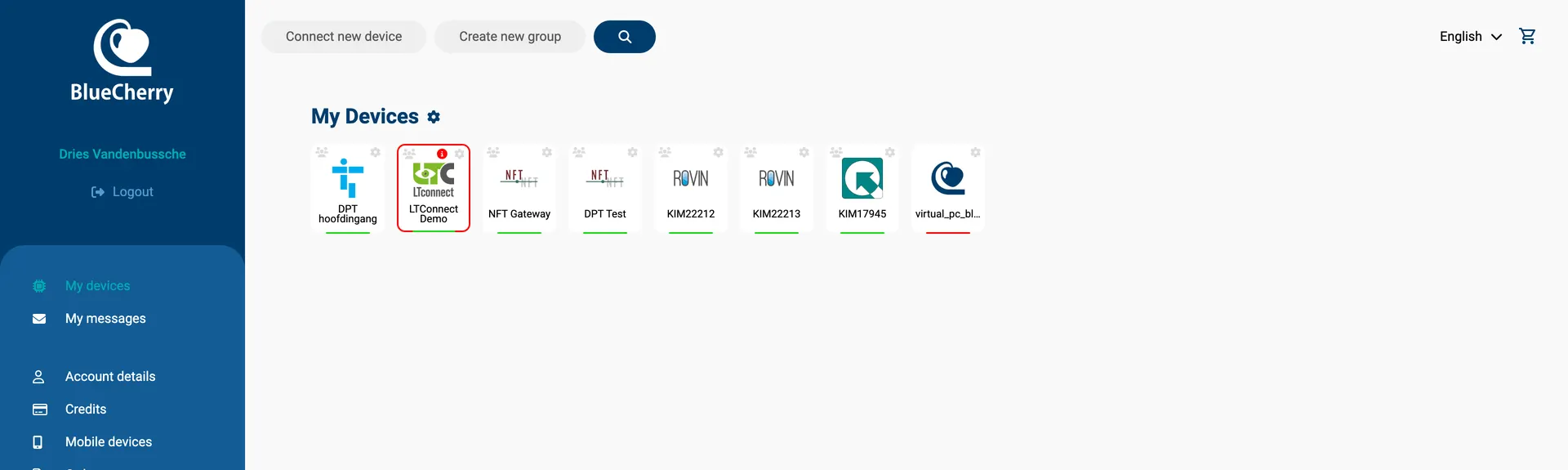
BlueCherry.io
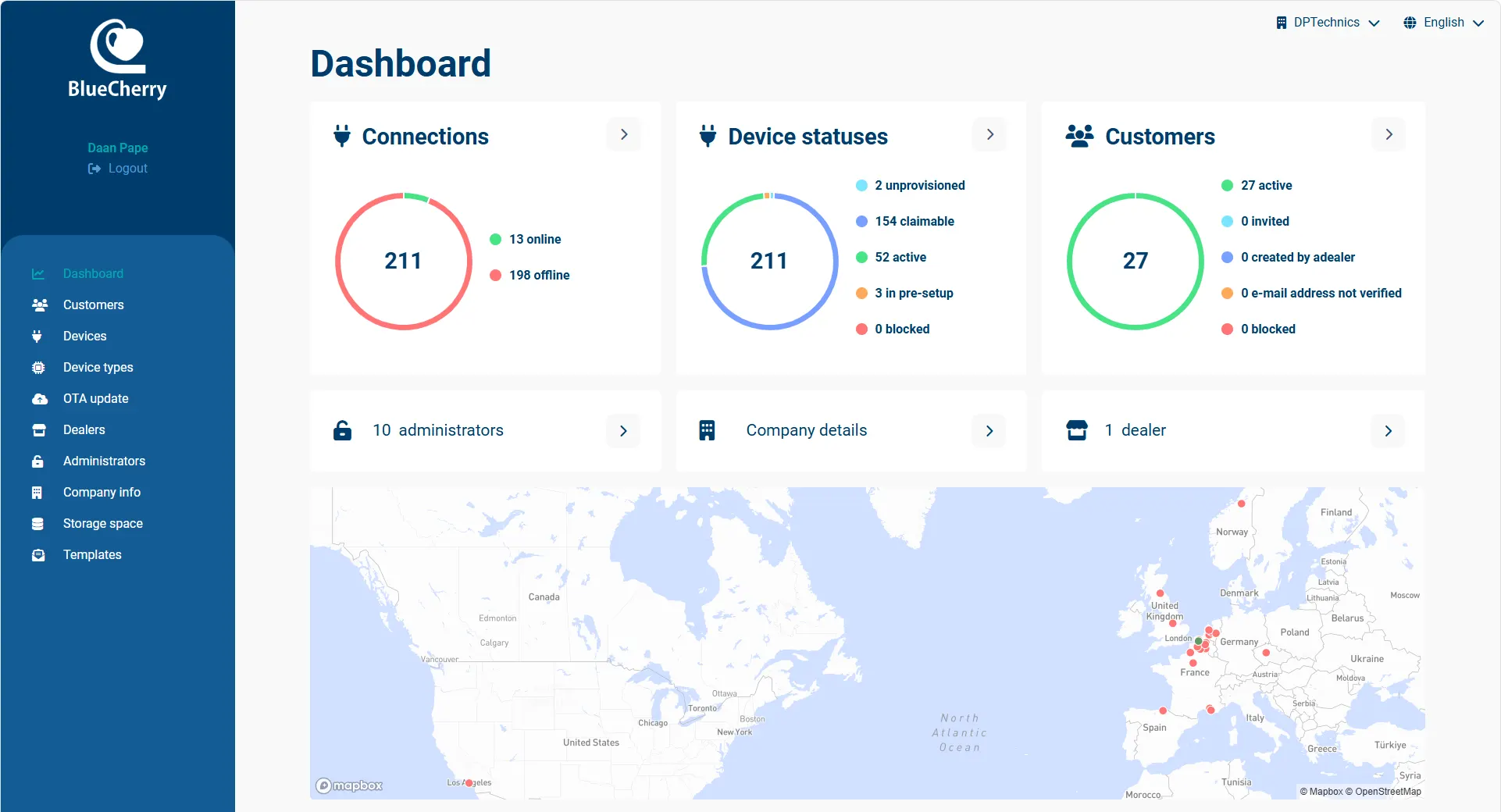
A fully encrypted IoT platform that keeps no private device data in the cloud. Smart devices, not a smart cloud, which is why there is no lock-in and why response times feel local.
Most IoT platforms made the cloud smart and the device dumb. The device then cannot do its job when the connection drops, and you cannot leave the vendor without rewriting the product. BlueCherry was built the other way round. The full software stack runs on the device, and the platform is an optional extension of it.
That inversion has consequences you can measure. A direct connection to the device does not round-trip through a data centre, so the interface responds at local speed. Streamed securely over the internet through our distributed server platform it is around 30 milliseconds. It also means the platform holds no private device data, so it is GDPR compliant by design and there is nothing to migrate if you ever leave.
The platform supports Full devices, which run embedded Linux and work entirely on their own, and Lite devices, which are constrained microcontrollers that lean on the platform for the interface and for analysis. Transport is flexible: the BlueCherry tunnel, HTTPS, WebSockets, MQTTS, SFTP, SCP, CoAP over DTLS, raw UDP and raw TCP, with new protocol bridges added when a project needs one.
Specifications
- Full devices run everything locally on embedded Linux, with the cloud optional
- Lite devices put data capture and local processing on the device, interface and analysis in the platform
- Encrypted end to end, with no private device data held in the cloud
- Notifications by email, SMS, virtual phone call and push
- FOTA and OTA daemon for firmware updates in the field
- BlueApp management portal, fully white-labelled in your own brand
- Transparent single monthly price, servers in a Belgian data centre
- More than three million platform messages a day
04 Linux system-on-module
DPT-Module
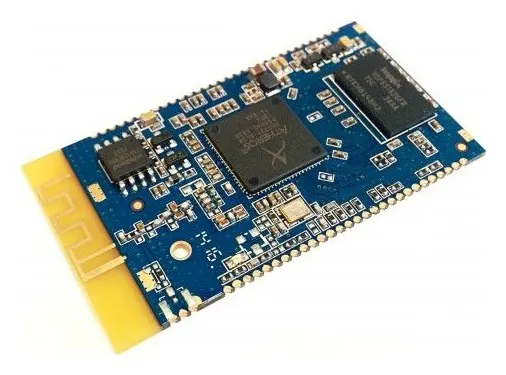
A 27.5 by 52 mm OpenWrt Linux module with a factory-calibrated WiFi radio. The workhorse behind the products that need a real operating system on the device.
The DPT-Module is the oldest product in our range, and still the right answer whenever a device needs a full operating system rather than a microcontroller. It is built around the Qualcomm Atheros AR9331, a system-on-chip designed for continuous operation and secure networking, with 64 MiB of DDR2 RAM and 16 MiB of flash on a module of 27.5 by 52 mm.
The WiFi transceiver and antenna are calibrated and tuned in the factory, so the radio performs the same on every unit. All the high speed circuitry lives on the module, which is what makes the carrier board around it straightforward to design and to certify. The module itself is CE and FCC certified for domestic and industrial use.
It ships with the OpenWrt-based DPT-Board OS, published on GitHub, or with your own stack installed from the factory. After boot there is still more than 10 MiB of flash and more than 34 MiB of RAM available to your application. Modules are delivered in trays ready for a pick-and-place machine and survive a second pass through the reflow oven.
Specifications
- Qualcomm Atheros AR9331 system-on-chip, built for continuous operation
- 64 MiB DDR2 RAM and 16 MiB flash on a module of 27.5 by 52 mm
- Factory-calibrated and tuned WiFi transceiver and antenna
- OpenWrt-based DPT-Board OS, open source, or your own stack from the factory
- CE and FCC certified for domestic and industrial use
- Around 0.3 W with the WiFi connection associated
- Over 10 MiB of flash and over 34 MiB of RAM left for your application
- Delivered in trays, reflow capable, designed for manufacturing
Side by side
Which block fits which product
The short version. Two cellular modules that differ only in network profile, a platform, and a Linux module for devices that need a real operating system.
| Building block | Walter | Walter Cat 1 bis | BlueCherry.io | DPT-Module |
|---|---|---|---|---|
| What it is | Cellular module | Cellular module | IoT platform | Linux system-on-module |
| Connectivity | LTE-M, NB-IoT, WiFi, BLE, GNSS | Cat 1 bis, WiFi, BLE, GNSS ready | Any IP link, and satellite where a project needs it | WiFi b/g/n |
| Certification | CE, FCC, IC, RCM, UKCA | CE, FCC, IC, RCM, UKCA | Not applicable | CE, FCC |
| Power | 9.8 uA in deep sleep | Not published yet | Not applicable | About 0.3 W with WiFi associated |
| Size | 55 x 24.8 mm | 55 x 24.8 mm | Not applicable | 27.5 x 52 mm |
| Software | ESP-IDF, Arduino, MicroPython, Zephyr, Toit | Same stack as Walter | Web portal, white-label app, FOTA | OpenWrt Linux, DPT-Board OS |
| Best for | Battery powered sensors and trackers | Wider coverage and higher throughput | Getting devices you already build online | Devices that need a full operating system |
| Availability | Available now | Q4 2026 | Available now | Available now |
| Where to get it | QuickSpot.io | QuickSpot.io | BlueCherry.io | Talk to us |
Not sure which block fits your product?
Describe the device, the power budget and the coverage you need. We will tell you which building block applies, and where a custom design is the better answer.
- DPTechnics HQ (EU) info@dptechnics.com +32 50 62 13 79
- DPTechnics USA usa@dptechnics.com +1 888 288 6605